
What Is Rare Disease Market Research?
Rare disease market research systematically gathers clinical, economic, and patient-centered evidence from verified rare disease specialists, patients, and caregivers. Teams use these insights to shape drug development, regulatory strategy, market access, and commercial planning. For a program overview, see MedPanel rare disease market research services.
Moreover, rare disease market research is not a subset of general market research. Instead, it is a distinct discipline that requires different panels, different recruitment infrastructure, different study designs, and a deeper understanding of the regulatory and clinical environment for rare disease programs.
Therefore, this guide explains what rare disease market research is, why it requires specialized methods, who commissions it, and how MedPanel rare disease research approaches it differently from generalist research vendors.
Rare Disease Market Research: US, EU, and Clinical Thresholds
First, the definition of a rare disease varies by jurisdiction, and those distinctions matter for rare disease market research design and regulatory strategy.
In the United States, the Orphan Drug Act of 1983 defines a rare disease as one affecting fewer than 200,000 Americans — a prevalence threshold of roughly 1 in 1,650. Consequently, sponsors can pursue FDA Orphan Drug Designation and unlock development incentives, including seven years of market exclusivity, tax credits on clinical trial costs, and waived FDA application fees.
In the European Union, the threshold is more restrictive: fewer than 5 in 10,000 people, or approximately 1 in 2,000. The European Medicines Agency awards EU Orphan Designation and provides ten years of market exclusivity, along with protocol assistance and reduced regulatory fees. Furthermore, European clinical and policy literature most often cites the 1-in-2,000 prevalence rule when researchers and regulators discuss “rare disease.”
Beyond these regulatory definitions, clinical practice recognizes ultra-rare disease — typically prevalence below 1 in 100,000. This threshold matters enormously for feasibility. For example, a condition at the EU rare disease threshold may have several hundred thousand diagnosed patients globally.
By contrast, an ultra-rare condition may have only a few thousand diagnosed patients worldwide, with treating specialists numbered in the hundreds. Therefore, research design must account for that reality from the outset.
Why Rare Disease Market Research Cannot Use Standard Panels
Most market research infrastructure targets common conditions and consumer populations. The panels that dominate general healthcare market research rely on self-reported credentials, recruit at scale from broad professional and consumer databases, and assume that teams can always find more eligible respondents if a study runs short.
However, none of those assumptions hold in rare disease market research. Specifically, the structural failures are clear. Compare this with verified patient recruitment services built for specialty populations.
Credential verification.
In standard panels, a physician can self-identify as a neurologist, an oncologist, or a rheumatologist — and the panel accepts that claim. In rare disease, the relevant credential is not a specialty but a practice pattern: does this physician currently treat patients with the target condition, and at what volume? For instance, a neurologist who saw one case of spinal muscular atrophy in residency and a neuromuscular specialist who manages thirty SMA patients are not equivalent respondents. Self-reported panels cannot make this distinction; verified panels can.
Population scarcity.
For a condition affecting 1 in 50,000 people, no consumer-facing panel offers meaningful penetration into the diagnosed patient community. Likewise, no claims database reliably identifies them at scale.
Therefore, teams must build relationships with patient advocacy organizations such as NORD, connect to disease-specific registries, and follow physician referral chains through specialist centers where patients cluster. Moreover, this infrastructure takes years to develop; you cannot improvise it for a single study. See rare disease patient recruitment for MedPanel’s approach.
Competing research burden.
In rare disease, natural history studies, clinical trial recruiters, academic researchers, and market research vendors repeatedly approach the same finite population of patients and specialists. Meanwhile, patient communities facing heavy research burden often disengage. Therefore, responsible rare disease market research accounts for this load and builds study designs that minimize participant fatigue while maximizing the value of each engagement.
Misdiagnosis and diagnostic odyssey.
Many rare disease patients carry incorrect diagnoses for years before clinicians confirm the correct one. For example, a patient with Fabry disease may appear in records for years as having chronic kidney disease of unknown origin. Similarly, a patient with myasthenia gravis may carry a prior diagnosis of anxiety or conversion disorder. Standard recruitment that searches only for the correct diagnosis in records will systematically miss these patients — and they are among the most important to reach.
Who Commissions Rare Disease Market Research
Across the full development and commercialization lifecycle, four primary buyer types commission rare disease market research:
Pharmaceutical and biotechnology companies
Pharmaceutical and biotechnology companies commission most of this work. Early-stage biotech teams run unmet-need studies to guide platform decisions.
Late-stage pharma teams build market access evidence packages for HTA submission. Moreover, research objectives shift by phase: early programs need clinical landscape and physician behavior data, whereas late programs need payer evidence, patient burden quantification, and commercial forecasting inputs.
Contract research organizations (CROs)
Contract research organizations (CROs) also commission rare disease market research within broader integrated development programs. For example, they use these studies to support site feasibility assessment, patient identification for clinical trials, or evidence synthesis for regulatory submissions.
Patient advocacy organizations
Patient advocacy organizations commission market research as well — particularly patient burden studies, unmet need assessments, and caregiver impact research. Consequently, they build evidence for disease awareness campaigns, policy advocacy, and pharmaceutical partnership negotiations.
Academic and health technology assessment researchers
Academic and health technology assessment researchers commission rare disease population studies too. They use outputs to support natural history research, epidemiological modeling, and health economic analyses that feed HTA submissions and public health policy.
Additionally, each buyer type has different output requirements, compliance environments, and tolerance for methodological tradeoffs. Therefore, rare disease market research design should reflect those differences. Explore case studies and expert recruitment services for related programs.
MedPanel’s Approach to Rare Disease Market Research
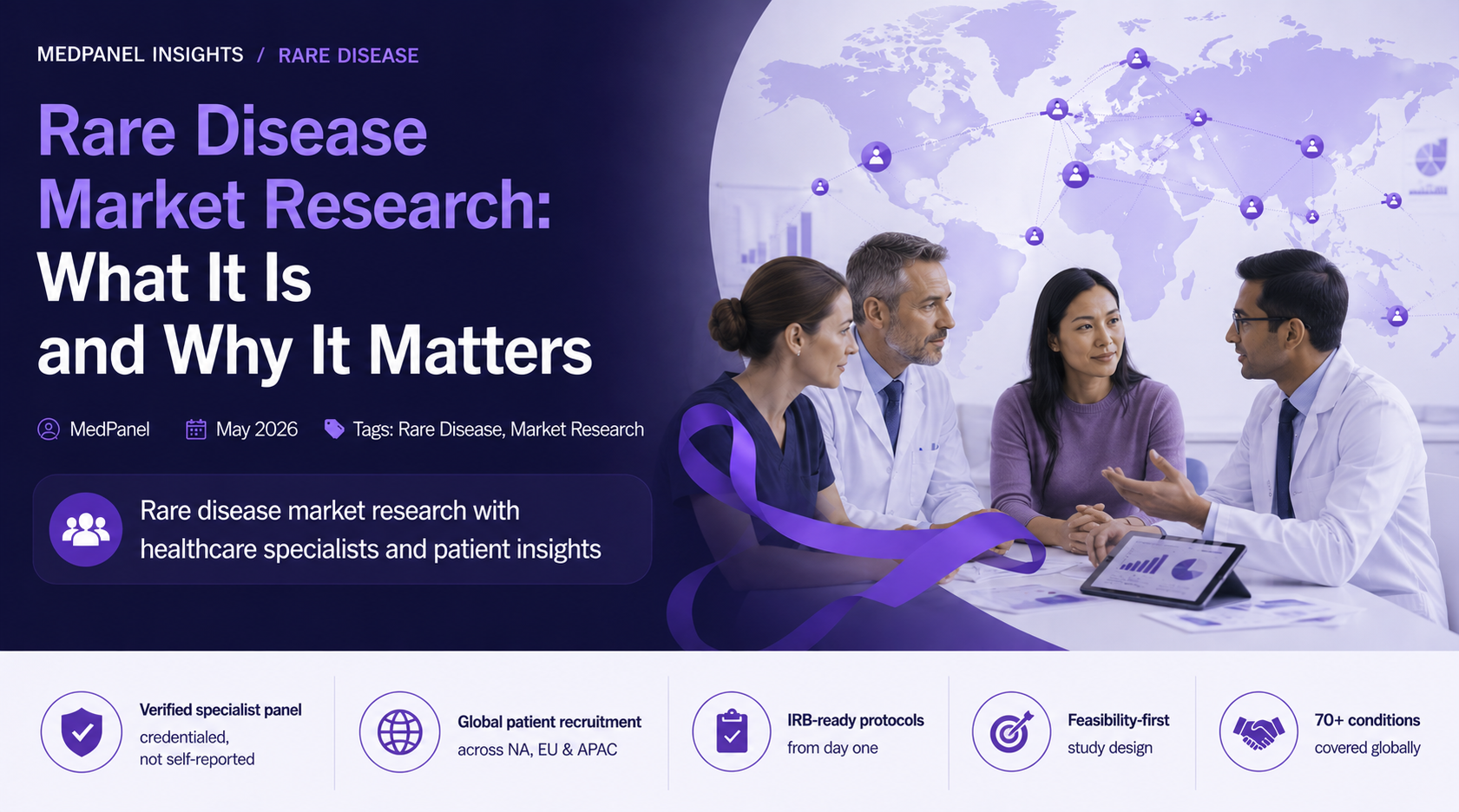
MedPanel built its practice for this environment. Furthermore, our rare disease market research capability rests on four structural foundations that distinguish us from generalist research vendors:
A verified rare disease specialist panel.
MedPanel credentials physicians against primary professional data sources — not self-reported job titles. When we recruit a treating hematologist for a rare platelet disorder, we verify that status first. Consequently, study findings reflect actual clinical practice rather than noise from under-qualified respondents.
Global patient and caregiver recruitment infrastructure.
MedPanel recruits rare disease patients and caregivers through direct partnerships with patient advocacy organizations, disease-specific registries, and physician referral networks. Moreover, our reach extends across North America, Europe, and select Asia-Pacific markets — essential when adequate sample sizes require crossing geographies. You can learn more on our rare disease patient recruitment page and how we work overview.
IRB-ready protocols from day one.
Every MedPanel study involving patients or caregivers aligns with Institutional Review Board submission requirements from day one, so teams avoid costly retrofitting. In addition, our research team includes compliance professionals experienced in rare disease research ethics, and we build protocols to withstand scrutiny from pharmaceutical legal teams and academic ethics boards alike.
Feasibility-first study design.
Before any rare disease study enters design or budgeting, MedPanel conducts a structured feasibility assessment. We map the accessible population, specialist community, advocacy landscape, and competing research burden.
Therefore, the feasibility output shows what is truly achievable — including sample size constraints and field timelines — rather than a projection designed to win the engagement. Likewise, our physician recruitment capability applies the same feasibility logic to specialist respondent panels.
Talk to a Rare Disease Market Research Expert
If you are scoping a rare disease research program — at any stage of development, for any therapeutic area — the most useful first step is a conversation with someone who has designed studies in this environment before.
Moreover, MedPanel’s rare disease research experts can review your brief, advise on study design, assess feasibility for your target population, and provide a clear-eyed assessment of timeline and budget requirements before you commit resources.
Therefore, email info@medpanel.com with your condition, target respondent type, and research objectives. We will respond within two business days.