
Introduction
You scoped the study carefully. Your incidence estimate came from a published research paper. In addition, your medical affairs team reviewed the screener. As a result, the fieldwork kicked off on schedule.
However, three weeks later you have completed only 4 of 30 target interviews — and you suspect two of those may not be real patients. Consequently, the timeline has doubled and the budget is now under review.
This is not an unusual scenario in rare disease patient recruitment. In fact, it is the most common one — because the same four or five core mistakes repeat across firms, disease areas, and research designs often enough that they deserve to be named and solved directly.
Below, you will find a clear framework built from MedPanel’s experience across hundreds of rare disease studies. Each failure mode is real, the fixes are specific, and importantly, none of them require starting over.
Failure Mode 1
The Incidence Estimate Is Wrong
What it looks like
Fieldwork begins and screener completion rates look fair, but qualifying patients are extremely rare. As a result, the research operations team keeps extending the field period. Meanwhile, costs pile up. Eventually, the study team starts asking whether they need to cut the target sample size.
Why it happens
Most incidence estimates in rare disease research come from published prevalence data — which measures how many people live with a condition, not how many doctors have diagnosed, treated, and can reach through research channels. Therefore, for many rare diseases, the gap between prevalence and actual research-ready incidence is a factor of 5 to 10 or more.
Research papers report lifetime prevalence in general populations. However, research recruitment needs diagnosed patients who actively know about their condition, can describe it in screening terms, and are willing to take part. As a result, that filtered group is only a fraction of the headline prevalence figure.
The fix
Before scoping any rare disease study, check your incidence estimate against three data sources: published prevalence, diagnosis rate (what share of estimated cases doctors have formally diagnosed), and research access rate (based on your specific recruitment channels). A responsible research partner will already hold benchmarks for these three metrics across dozens of conditions from past study work. If they don’t, that alone is a warning sign.
Rule of thumb
For conditions with prevalence below 1 in 10,000, assume your reachable research pool will be 20–40% of published prevalence figures. Similarly, for ultra-rare conditions (below 1 in 50,000), assume only 10–15%. Therefore, build your timeline and budget from these cautious figures — not from headline prevalence.
Failure Mode 2
The Screener Doesn’t Match How Patients Identify
What it looks like
Plenty of people attempt the screener, but very few qualify. On the other hand, a strangely high pass rate sometimes leads to respondents who fall apart under interview questioning.
Why it happens
Standard screeners ask simple yes-or-no questions: ‘Has a doctor diagnosed you with [condition name]?’ This works for common conditions with stable naming. However, for rare diseases it fails for three reasons. First, patients often know their condition by an everyday name, an older term, or a subtype name their specialist uses. Second, diagnosis is often a process rather than a single event — a doctor may have told patients ‘you probably have X’ years before they receive a formal code. Third, doctors may have misdiagnosed some patients so many times that those patients feel uneasy about confirming any diagnosis at all.
The fix
You should develop screeners for rare disease studies with input from at least one relevant disease specialist — and ideally from a patient advocacy group. Specifically, they should include: (a) symptom-based paths as options beyond diagnosis confirmation, (b) all commonly used synonyms and other names for the condition, (c) a treatment or medication question as a supporting screener item, and (d) a sub-question that separates specialist diagnosis from general doctor suspicion.
In short, a screener that correctly finds patients with a rare condition is itself a piece of clinical knowledge. Therefore, you should write it like one.
Failure Mode 3
Verification Is an Afterthought
What it looks like
Fieldwork completes on time and data looks sound. However, during data review or client debrief sessions, individual respondent accounts show gaps — drugs mentioned don’t match the condition, treatment timelines don’t align with approved therapies, and basic clinical knowledge is missing. As a result, the data becomes suspect. In some cases, you may need to discard interviews entirely.
Why it happens
Research recruiters under timeline and budget pressure often treat verification as friction they want to reduce. After all, a self-report screener is faster and cheaper to run than one with added checks. However, when you offer high rewards — and for rare disease studies you often must, given how scarce respondents are — the risk of people lying about their condition becomes very real.
The fix
You should build tiered checks matched to study stakes. At a minimum, require proof of diagnosis source (a named specialist or specialist center), drug confirmation (which specific therapy and from which date), and one supporting document from the list below. Furthermore, for studies used in regulatory work, require medical portal proof or a doctor-confirmed referral.
- MyChart or equivalent patient portal screenshot showing relevant ICD-10 code
- Specialty pharmacy dispensing record or prescription label
- Lab result relevant to the condition (e.g. factor level for hemophilia, alpha-galactosidase A enzyme activity for Fabry disease)
- Specialist center treatment record header
Yes, these steps add friction. However, they also produce a sample you can defend to a client, a reviewer, or a journal editor. Above all, that outcome is worth the extra effort.
Failure Mode 4
Using General Panels for Ultra-Rare Conditions
What it looks like
Your research operations team routes the study through a standard online panel. The panel vendor gives you access to millions of US adults. However, after three weeks you have screened 180,000 people and only six qualify — and two of those fail the check step.
Why it happens
Companies build general research panels for common conditions, consumer behavior, and opinion research. As a result, these panels have no real depth in rare disease groups. In other words, using them for ultra-rare disease research is like fishing for trout in the ocean — yes, it is a body of water, but it is almost certainly the wrong one.
The fix
For any condition with prevalence below 1 in 10,000, route recruitment through focused channels before or instead of general panels: disease-specific patient advocacy groups, rare disease patient registries, specialist physician referral networks, and disease-specific online communities. General panels can support these channels, but they should never serve as the main source.
Importantly, MedPanel’s patient recruitment model does not rely on a single in-house panel. Instead, we build condition-specific strategies that combine physician networks, PAO partnerships, digital community outreach, and targeted advertising — weighted based on the condition and study design.
Failure Mode 5
Ignoring the Caregiver Population
What it looks like
The study design specifies ‘patients with [condition].’ Then data collection begins, and the research team quickly realizes that many of the most useful insights come from parents of young patients, spouses of patients with cognitive limits, or family caregivers who manage every part of a patient’s treatment. Unfortunately, the team did not plan for these respondents in the screener, the reward structure, or the discussion guide.
Why it happens
Research designs default to the patient as the main focus. However, for rare diseases that start in childhood — many metabolic conditions, some nerve and muscle conditions, some immune conditions — the caregiver is the main decision-maker and often the most informed respondent you can find. Therefore, leaving them out is not a neutral choice; it is a flawed one.
The fix
During your pre-study disease review, check whether the condition has major childhood prevalence, notable cognitive or physical limits in adults, or a strong caregiver advocacy community. If any of these apply, design a separate caregiver recruitment stream from the start. Specifically, you should adapt the screener, discussion guide, and reward structure for caregivers on their own — rather than tacking them on as an afterthought to patient materials.
Failure Mode 6
Mishandling the Compliance Layer in Multi-Country Studies
What it looks like
You need 40 US patients and 20 EU patients. US recruitment wraps up smoothly. However, EU recruitment stalls. Then you discover that the data collection platform does not meet GDPR rules for EU residents, or that someone did not localize the consent form correctly, or that data transfer to a US-based client breaks the rules. As a result, you must restart the EU part entirely.
Why it happens
Research operations teams who only know US studies sometimes apply US compliance rules globally without seeing the gaps. However, GDPR rules for clear consent, data limits, and cross-border transfer differ sharply from HIPAA rules. In fact, they are not swappable at all.
The fix
For any multi-country rare disease study, confirm the following before fieldwork begins: (1) each country’s data collection platform meets local data protection law, (2) legal counsel in each region has reviewed region-specific consent forms, (3) your data transfer and storage setup meets GDPR and Standard Contractual Clause rules where they apply, and (4) your ISO-20252 certified processes cover global fieldwork. Most importantly, these steps are not optional for studies you plan to publish, share with regulators, or use in any formal filing.
Failure Mode 7
Treating Rare Disease Patients as One-Time Respondents
What it looks like
The study wraps up. The team thanks and pays respondents. However, nobody sends any follow-up message. Then, eighteen months later, the research team comes back for a new study and finds that past respondents have dropped off, are harder to reach, or have heard bad things about the first study through community channels.
Why it happens
General market research culture treats respondents as swappable. However, rare disease communities are not swappable at all. Instead, they are small, tight-knit groups with long memories, where a researcher’s name — good or bad — spreads fast.
The fix
You should invest in post-study relationship care. For example, share grouped findings (with all personal details removed) with those who opted in to receive them. Also, credit their input in papers where fitting, and follow up on promises you made during recruitment. As a result, rare disease patients who feel truly respected by a research group become long-term research partners — ready for follow-up studies, advisory boards, and co-creation work that no screener database can match. This is not charity. In fact, it is the most cost-effective rare disease research investment you can make.
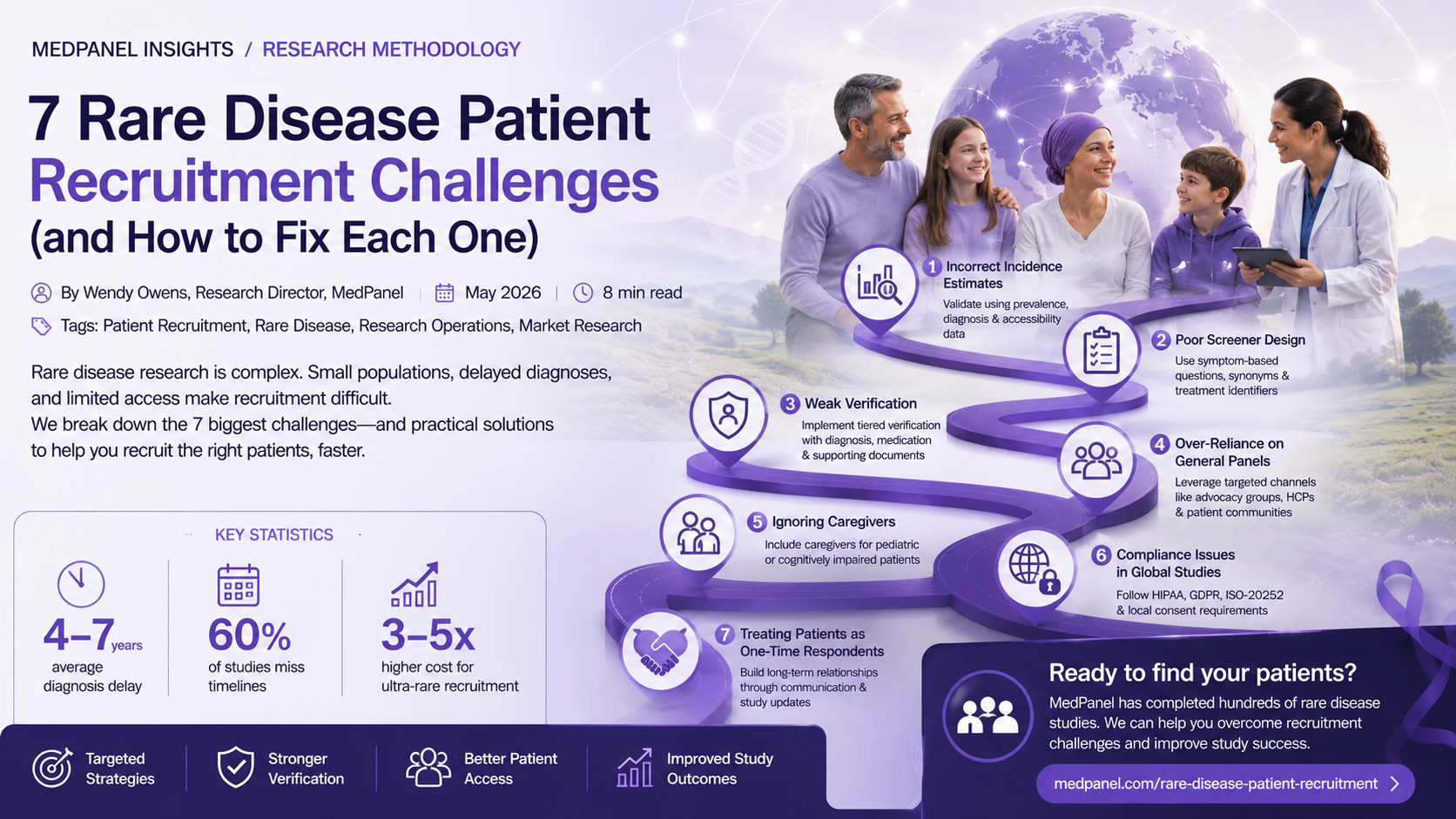
Key Statistics
4–7 yrs
Average diagnosis delay for rare disease patients
60%
Of studies fail timeline due to incidence underestimation
3–5x
Cost premium for ultra-rare vs. general population recruitment
A Checklist Before Your Next Rare Disease Study
- Validate incidence estimate against prevalence, diagnosis rate, and accessibility rate
- Develop screener with specialist input and patient advisory review
- Define verification methodology matched to study stakes before fieldwork begins
- Confirm recruitment channels are appropriate for the specific condition’s prevalence
- Design for caregiver populations if condition has pediatric or cognitive impairment prevalence
- Verify compliance framework covers every jurisdiction in scope
- Plan post-study communication for respondent relationship maintenance
Ready to find your patients?
MedPanel has completed hundreds of rare disease studies. As a result, we can audit your study design before fieldwork begins — contact us to discuss.