
Introduction
Recruiting rare disease patients for market research sounds straightforward until you try it. A condition affecting fewer than 200,000 people nationally may have no organized patient community, unreliable diagnosis rates, and a population scattered across dozens of specialist centers — none of which makes for an easy screener call.
Yet the insights these patients carry are irreplaceable. Their experience of diagnosis delay, treatment burden, and unmet need is the primary compass pharmaceutical and biotech companies use to develop drugs that actually fit patient lives. Done well, rare disease patient recruitment produces data that shapes trial design, informs launch strategy, and influences regulatory submissions. Done poorly, it produces a sample that misrepresents the reality of a condition and leads development teams in the wrong direction.
This guide covers the methodologies, verification standards, and common pitfalls that separate credible rare disease research recruitment from the kind that leaves you questioning whether your respondents actually have the condition you’re studying.
Key Statistics
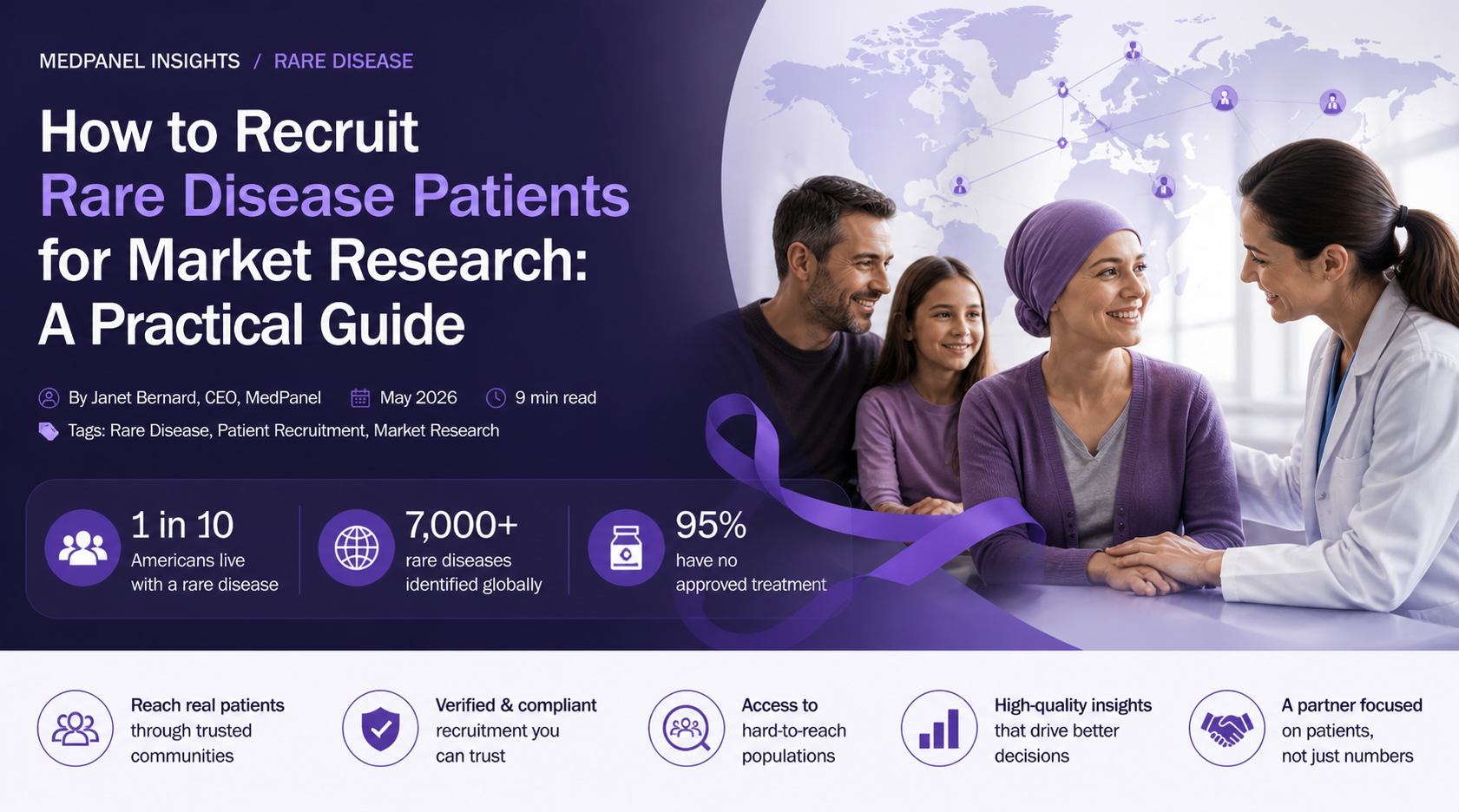
1 in 10
Americans live with a rare disease
7,000+
Distinct rare diseases identified globally
95%
Have no approved treatment
Why Rare Disease Recruitment Is Fundamentally Different
Standard healthcare market research recruitment relies on scale. You screen thousands of panelists, quota-fill your target groups, and field within days. Rare disease recruitment has none of these properties. The differences fall into three categories:
1. Population Scarcity
A condition like tuberous sclerosis complex affects roughly 1 million people worldwide — about 1 in 6,000 births. Hereditary angioedema affects perhaps 1 in 50,000. In a general consumer panel of 500,000 opt-in members, the expected number of HAE patients is ten. After accounting for those who are inactive, unwilling to discuss their condition, or ineligible for your specific study criteria, you may have two or three viable respondents. That is not a research panel — it is a coincidence.
This means rare disease patient recruitment cannot be database-driven in the conventional sense. It requires active, targeted outreach through channels that have genuine access to diagnosed patients: specialist practices, disease advocacy organizations, patient support groups, and patient-facing digital communities.
2. Diagnosis Complexity
Rare disease patients frequently carry a diagnosis they received years into their symptom journey. The average rare disease patient waits 4–7 years from symptom onset to correct diagnosis. During that time they accumulate incorrect diagnoses, self-diagnoses, and a complicated relationship with medical terminology. A screener that asks ‘have you been diagnosed with [condition]’ will miss patients who know their condition by a different name, a related syndrome, or a colloquial term their physician uses.
Effective screeners for rare disease research are written with disease specialists, not pulled from a standard template. They use symptom-based qualification paths, include alternative nomenclature, and account for the difference between ‘diagnosed by a specialist’ and ‘told by a GP I might have.’
3. Respondent Burden and Trust
Rare disease patients are a small, interconnected community. Word travels quickly when a research firm is conducting studies carelessly — recruiting with insufficient verification, misrepresenting purpose, or not compensating fairly. Conversely, firms that build a reputation for respecting patient time and expertise can access that community repeatedly across studies. Rare disease patient recruitment is not a transaction — it is a relationship that compounds over time.
“The rarest part of rare disease research isn’t finding the patients. It’s building the trust that makes them want to participate — and come back.”
— Janet Bernard, CEO, MedPanel
The Five Methods That Actually Work
There is no single channel that solves rare disease patient recruitment. The most reliable studies use three or more of the following in combination:
Patient Advocacy Organizations (PAOs)
Disease-specific advocacy groups maintain the most current, verified lists of diagnosed patients of any organization outside a clinical center. The National Hemophilia Foundation, Global Genes, NORD, and hundreds of disease-specific groups have patient registries, newsletters, and social communities that researchers can partner with for recruitment outreach.
PAO partnerships require relationship-building, transparent study design disclosure, and usually some form of community benefit — sharing aggregated findings, supporting the organization’s research agenda, or co-authoring publications. The return is access to a highly credible, already-engaged patient pool.
Specialist Physician Referral Networks
For conditions managed by a small specialist community — haematologists for hemophilia, metabolic disease specialists for Fabry disease, neuromuscular specialists for myasthenia gravis — the treating physician is the most direct path to a diagnosed patient. Physician panels who agree to refer eligible patients for research participation, with appropriate privacy and consent protocols, are among the most reliable rare disease recruitment channels available.
This approach requires a verified physician network with pre-established research relationships — not cold outreach to practices. MedPanel’s community of more than 3,500 physicians across 60+ specialties includes specialists in the most commonly studied rare disease categories.
Digital Patient Communities
Facebook groups, Reddit communities, disease-specific forums, and patient networking apps have become primary gathering places for rare disease patients — often more active than official organization channels. A patient with a rare metabolic disorder is more likely to be in a private Facebook group with 800 members than attending a national conference.
Recruitment via digital communities requires careful IRB and ethics consideration, transparent researcher identification, and often moderation approval from community administrators. When done correctly, it reaches patients who are highly engaged with their condition and often eager to contribute to research.
Site-Based Recruitment Through Specialist Centers
Academic medical centers and large specialist practices frequently see concentrations of rare disease patients that exceed general population rates by orders of magnitude. A hemophilia treatment center may follow 200–300 patients; a lysosomal storage disorder clinic may see every diagnosed patient in a three-state region.
Site-based recruitment is slower and more resource-intensive than panel-based approaches, but it produces patients with verified diagnoses (confirmed in medical records), often with detailed clinical data available to contextualize their responses.
Targeted Digital Advertising
Condition-specific keyword advertising, rare disease hashtag targeting on social platforms, and programmatic advertising to audiences matching rare disease patient profiles can surface self-identified patients who are not reachable through organized communities.
This channel requires careful screening to filter condition imposters — a non-trivial problem when a condition has high social visibility. It is most useful for supplementing other channels and reaching newly-diagnosed patients who have not yet joined organized communities.
Verification: The Non-Negotiable Standard
A rare disease patient recruitment study is only as valid as its verification methodology. Without systematic verification, you risk recruiting respondents who believe they have the condition but are undiagnosed, who have a related but distinct condition, or — in high-incentive studies — who are misrepresenting themselves entirely.
Minimum Verification Standard
For any rare disease patient recruitment study, at minimum:
- Condition-specific screener with medical input
- Self-attestation of diagnosis source
- At least one corroborating signal
Studies without this standard should not be used for regulatory submissions or clinical development decisions.
Advanced Verification Methods
- Medical portal screenshots (MyChart, Epic)
- Prescription records for condition-specific meds
- Lab documentation (metabolic/genetic conditions)
- Physician-confirmed referral from specialist
- ICD-10 code confirmation via medical record audit
Compliance Framework: HIPAA, GDPR, and ISO-20252
Rare disease patient recruitment involves sensitive health information across multiple jurisdictions. Studies routinely recruit patients in the US, EU, UK, and APAC simultaneously — each with different privacy requirements. Compliance must be built into recruitment design, not retrofitted.
Common Mistakes and How to Avoid Them
❌ Underestimating Incidence in Screener Math
If you plan for a 1-in-500 incidence rate and the true diagnosed prevalence is 1-in-5,000, your fieldwork timeline will be ten times longer than projected.
❌ Writing Screeners Without Medical Input
Screeners written by research operations teams without disease specialist review consistently miss patients or misclassify them.
❌ Setting Incentives Too Low
An incentive that reflects the genuine value of patient time and expertise is the price of access to a credible respondent.
❌ Ignoring Caregiver Populations
For pediatric rare diseases and cognitively impaired populations, caregivers are the primary respondent.
What to Expect From a Qualified Recruitment Partner
- What is your verification methodology for [specific condition]?
- What are your sources for patient access?
- How do you handle global compliance?
- What is your disease-specific experience?
- What is your publication track record?
Conclusion
Rare disease patient recruitment requires more than scale. It demands precision, trust, and verified access.
MedPanel operates where patients actually live — beyond traditional systems. As a result, we help researchers access hard-to-reach populations and generate reliable insights.
Ready to find your patients?
Discuss your rare disease patient recruitment study with a MedPanel specialist — typically within 24 hours.